Against the Machine: On the Unmaking of Humanity (Paul Kingsnorth)
A bold and insightful, but somewhat flawed, exposition of what is wrong with the modern world, and what to do about it.

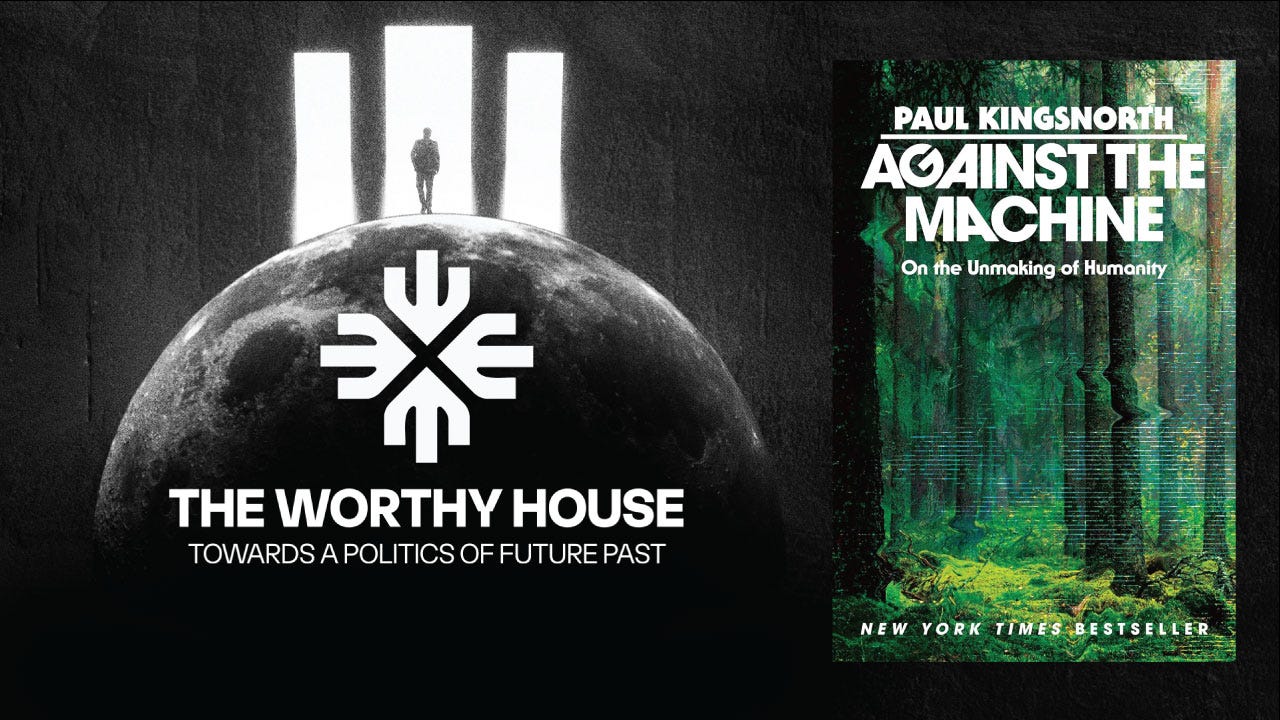
In the Book of Daniel, the prophet interprets Nebuchadnezzar’s dream of an awesome statue. It boasts a golden head and silver body, but it has feet of iron mixed with clay. And when those feet are smashed, the precious metals collapse, becoming “like dust on the summer threshing floor, and a great force of wind blew them away.” Paul Kingsnorth sees what the Faustian West has built as this statue, a mighty yet inhuman and flawed idol to Progress, fated to come to the same end. He sees this demise as good and inevitable, if traumatic. I am not so sure. Regardless, this is the question of the age—which way, Western man?
Against the Machine is a challenging book. Its central conceit is that mankind is being overwhelmed by what Kingsnorth has named the Machine, a protean and still-aborning anti-human force of, most likely, our own creation. This is a book about the West, not only because we are men and women of the West, but because the West is the sole creator of the modern world, in all its good and all its bad elements, including the Machine. And it is a book trying to figure out what comes next, because the West, as it has existed for more than a thousand years, lies on its deathbed. Its most crucial organ, its beating heart, Christendom, has already failed. What remains is a shambling blob, pulled this way and that by its remaining parts, each seeking to be the core of a new thing. To be sure, as always in history, the West will be replaced. But, Kingsnorth says, it is being replaced by something entirely new in history. He is here to tell us to repent, in the sense of the Greek metanoia—to turn back, to change our minds.
“[T]here is a throne at the heart of every culture, and whoever sits on it will be the force you take your instruction from.” We have inherited fantastic material wealth, but we cannot agree on what sits, or will sit, on that throne, and so we are adrift. We cannot agree because we are have lost our roots, and we are seeking to become rooted again, by placing a new figure on the throne. The Machine bids to become that monarch.
The outlines of what the Machine is are Part One and Part Two of the book. The dynamo which drives the Machine is the modern obsession with economic growth. Maybe because he is English, Kingsnorth does not mention Henry Adams, who more than a hundred years ago in Mont-Saint-Michel and Chartres (as well as in The Education of Henry Adams) contrasted the inhuman, ever-expanding power of the Dynamo with the humanity of the actual Virgin, the Mother of God, an early manifestation of this same line of analytical thought. From the demand for growth at all costs arises inevitable centralization of power, resulting in loss of all of community, organic ways of living, and personal household independence—that is, loss of all that makes a society as society viable.
The modern era of centralization through growth began deceptively simply, centuries before the Industrial Revolution, with the enclosure of English common land. It was a seemingly small thing, if of significant impact on the common folk, but the impulse behind enclosure has today swallowed the entire West. Centralization is and always has been mediated and accelerated by technology, but never in an overwhelming way until modernity. Our peerless technology permits ever more production while accelerating centralization of power and control, by a few individuals, by corporations, and by the state. This centralization, however, is a form of depersonalization, which necessarily views men and women as tools to a fundamentally inhuman end. (Although Kingsnorth does not mention it, James C. Scott, in Seeing Like a State, identified this as the “cadastral,” or map-like, view taken by the powers of modernity—mankind as abstraction, not flesh and blood.)
For the centralizers, the desired and necessary end of this path is Jeff Bezos’s grand vision of a trillion humans spread throughout the Solar System—a remaking of mankind and a final break with our organic rootedness in the real things of Earth, brought about by the realization of Francis Bacon’s “knowledge of causes and the secret motions of things,” with the aim of “the enlarging of human empire, to the effecting of all things possible.” But none of this can be achieved, Kingsnorth says, without control, driven by will, and such level of control is fundamentally opposed to our rooted humanity. Rather, it atomizes, making each of us a cog in the Machine. What use glory, what does glory even mean, if men become mere parts in a giant engine?
But, one might object, Bezos’s is indeed a grand vision, not necessarily unreal or inhuman. Why not the expansion of mankind into Space? After all, this is a prime goal of mine, about which I have often written, and we will return to my response to Kingsnorth on this matter. His claim, however, is not only that in practice a grand vision of mankind promulgated as a goal, as a mechanical rabbit in front of a racing greyhound, is never realized. Rather, what we create through technology and centralization becomes merely a vehicle for granting us our immediate wants, while the quest for something larger is a chimera. Our wants are infinite and unless we are guided by a virtuous force greater than ourselves, they are corrosive, mere exercises in sensory gratification, which because we have lost our focus on spiritual matters, we falsely equate with happiness.
This is demonstrated, Kingsnorth says, by the constant cry of those seeking unbounded progress—that we must and we will end limits, that each man will be a little god. Or, put more malevolently by the Satanist Aleister Crowley, “Do what thou wilt shall be the whole of the law.” Certainly, a few brave men and women resist this call (Kingsnorth himself lives in rural Ireland, somewhat off the grid), but most of us are followers of the easy path which leads to apparently infinite pleasures, if left to our own devices. For man is fallen; limits are his nature, and denying this only leads to misery. We will, he implies, nearly all trade our humanity for satiety, if given the choice, despite that on our deathbeds, we will realize we chose poorly.
This arc of the West, on which Kingsnorth expands at length, is the “historical and philosophical development” of the Machine. The Machine is made of “technologies, and especially digital technologies.” “It is above all a new type of civilization; one which is replacing all previous human ways of living, cultures and value systems with something novel and totalizing; something which, in some indefinable way, seems to be struggling to be born through us.” “All of it leads here . . . towards the new techno-Babel we are building.”
There is much more here; Kingsnorth analyzes our modern predicament both through his own thought and by explicating the thought of many others. Oswald Spengler, prophet of Western disintegration and predictor of Caesarism. Alasdair MacIntyre, analyst of the hollowness that has consumed us. Lewis Mumford, historian of cities and civilization, who saw progress and growth as a sacral aim, a form of deification, from Ancient Egypt to the present day. Jacques Elul, who explained how the quest for what he called technique inevitably grew as men sought to master the world, and became the new bedrock of our own civilization, destroying the old bedrock of “nature, culture, and religion,” as seen in everything from agriculture to schooling to the unhinged global response to the Wuhan Plague.
It is all somewhat philosophical and the Machine is blurry, so in Part Three the author examines the specific manifestations of the Machine in our present age. Kingsnorth, with due hesitation, identifies our age as unique, because our culture is primarily one of negation, aimed at destroying all the values of pre-modern society, which he identifies as the “Four Ps”—past, people, place, and prayer. He opposes this to the “Four Ss”, the “theology of the Machine”—science, the self, sex, and the screen. The core aim of the Machine is, quoting Patrick Deneen, a desire for “freedom from external constraints,” and Kingsnorth expands on this point. Here, however, a confusion which mars this book shows up.
This desire for freedom, for emancipation from all unchosen bonds, is the main desire and aim of the Left, since the Enlightenment and 1789. Kingsnorth even repeatedly uses that date as the inception of the Machine. This necessarily means that anyone who opposes such emancipation is on the Right. Yet Kingsnorth does not want to be identified as a man of the Right, no doubt because he does not want to pigeonholed as a partisan actor. However, although he never directly addresses it, Kingsnorth surely also realizes that his message resonates only with those on the Right. (As far as I know, not a single publication on the Left has paid any attention to his recent writing.) He still struggles manfully to avoid identifying himself with the Right, in part because most of his life he has seen himself as a man of the (primarily environmental-focused) Left, and he fails totally.
When, as he often does, he lists modern vices, they are all vices characteristic of and deriving from the Left, even if he throws in references to the Right to appear even-handed. Thus, for example, he disparages “the mono-ethnic identitarianism of the far right [and] the ‘diversity’ identitarianism of the far left,” without acknowledging these are utterly different things with the same name, that the latter is an essential part of all leftist belief, not just the “far left,” and that the former (though his phrasing “mono-ethnic” is overstated) is precisely the type of rootedness for which he calls, as well as the standard reality-based position of every human society until the Left’s long march to triumph began 250 years ago. He then illogically conflates socialism, communism, and nationalism. And so on. These sorts of contradictions and category errors within his thought appear too often to count.
The key is that Kingsnorth does not accurately define what is Right and what is Left. When he talks about the Right, he means “global capitalism” or “corporate capitalism,” and complains it is in practice part of the Machine, part of the Left. He is correct that both are “engines for destroying customary ways of living and replacing them with the new world of the Machine.” He is also correct that what has passed for decades as “conservatism” is merely the Left going a little slower. But he is wrong that global capitalism has anything to do with today’s actual rising Right, the Effective Right, and he does not appear to see the distinction between the “Right” that is mere fellow traveler to the Left and the actual Right, either historical or contemporary. It is certainly true that many matters crucial to today’s Right, such as the living wage for a husband, were once the focus of currents within the Left, but they were purged long ago from the Left, because they did not fit within the Left’s actual goals. What is Machine is Left; what is anti-Machine is Right (including some of those who seek glory and use technology, for as we will discuss, one can seek to do those things without prostrating himself before the Machine), and either Kingsnorth does not see this or does not want to acknowledge it.
In any case, he is certainly correct that we live in an unprecedented age. Our elites hate their societies; he notes Christopher Lasch on the topic, and even more interestingly, the largely-forgotten Robert Bly, whom he cites with one of the most insightful quotes I have seen in a long time. “Is a hatred of one’s own a variant of self-hatred? Hardly so. One who hates what most people love probably savors his uniqueness. He believes that secession from his country, class, race, and species bespeaks righteousness and partakes of the heroic. But above all he has an almost insane vanity.” Such vanity was inconceivable in any past age, and much else about our time is also unique, including attempts to dissolve sex through transgender insanity; the elimination of traditional sex roles and the household economy; frantic attempts to defeat death; contempt by our leaders for their own nations and peoples (with the elites acting directly against the interests of both in the nations they lead); the crazed rush to eliminate borders; and the replacement of both nations and borders by what Kingsnorth calls the Grid, the “physical manifestation of the values of the Machine on the landscape itself.” What binds these malignant new things together is that they all view men and women as parts of the Machine, to be deployed for maximum efficiency and output, in service of supposed progress.
Penultimately, Kingsnorth takes this analysis a step further, into the metaphysical. “Humor me. Imagine for a moment that some force is active in the world which is beyond us. Perhaps we have created it. Perhaps it is independent of us. Perhaps it created itself and uses us for its ends. Either way, in recent years that force seems to have become manifest in some way we can’t quite put our finger on, and has stimulated the craziness of the times.” He at first gives this force the anodyne name Progress, as a placeholder, but what he really means, as he makes clear soon enough, is Antichrist.
Whatever its name and whatever exactly it is, this force seeks total liberation from everything: the end of history, the end of transcendence and the death of God, permanent revolution and the uprooting of all things. To move beyond nature, and, ultimately, to replace us. It uses the screen, digital technology, as its main tool, and it aims to create a new religion, for which it wages spiritual war, a war against reality. (And, again, since reality is the main characteristic of the Right, despite what Kingsnorth says, this is necessarily a war between Left and Right, and a simple man would immediately, and correctly, conclude, with René Girard, that this Antichrist is the apotheosis of leftism.) “The great mind is being built. The world is being prepared. Something is coming. Be ready.”
Finally, in Part Four, Kingsnorth takes a stab at what this metaphysics means for us, meaning those, unlike most, who perceive the menacing shadow of the Machine looming over us. He does not offer a call to save the West, which he says is, or was, “above all, a way of seeing.” Once that gaze was Christian, now it is the gaze of the Machine. We see the world very differently than did our ancestors, and that is why we are in the pickle we are in. He parses Ian McGilchrist, who wrote The Master and His Emissary, with his analysis of how we view the world through the left or right hemispheres of the brain, each with very different ways of “attending the world,” to conclude that “we are now losing contact with reality altogether, all the time imagining that we are ‘progressing’ towards it.” We see with the narrow left brain of machines and code, focusing only on parts of the world, and ignore the right brain, which sees the whole, the world as organism rather than machine.
Instead of saving the West, however, he calls to let it die. “We struck the iceberg long ago; it must be time, at last, to stop clinging to the shifting metal. To get go and begin swimming, out towards the place where the light plays on the water. Just out there. Do you see? Beyond, just beyond. There is something waiting out there, but you have to strike out to reach it. You have to let go.”
What’s Kingsnorth’s recommended plan as the West dies? He is somewhat diffident on this score, no doubt for good reason. Grand plans have not had a good track record for quite a few centuries. Mostly it is to “prepare the seedbed,” through individual and small group acts of “reactionary radicalism.” The Luddites, for example, who have been given a bad name by slaves of the Machine, were not reflexively anti-technology. Rather, they wanted to preserve their traditional ways of life, by applying technology “in a way which reinforced the moral economy rather than destroying it.” We should do the same, and the sum of this is “an active attempt at creating, defending, or restoring a moral economy build around the four Ps.”
To do this, we must circumvent the Machine. In part this means becoming ungovernable, by becoming as invisible as possible to the Machine. This means rejecting, as much as possible, all digital technology, most of all smart phones, albeit we should “cautiously accept that using the technology of the Machine to resist the Machine can be of benefit, even though it can also be a trap.” We should not confront the Machine, but slip through the cracks. We must live, in short, esoterically, and thereby “begin to dissociate ourselves from the Machine while creating alternatives to it.” For some, this will result in an extreme change in lifestyle (and here Kingsnorth could, but does not, adduce Theodore Kaczynski); for others, a partial change. To the maximum extent possible, each of should focus on eternal things. We do not know where this will lead, or by what resulting mechanisms the future can be reborn, but that is not for us to know.
I am skeptical of much of this set of recommendations, largely because the concrete examples Kingsnorth gives as exemplars are delusional. He repeatedly emphasizes that “indigenous and traditional communities” have much to tell us, which we have ignored and should recover, with “dreamtime” and “raindance.” This is perilously close to the insane view which believes, for example, that Australian Aborigines were wise sages living in harmony with the land, rather than retard-level savages who lacked fire and killed the old when they became inconvenient (and whose supposed Dreamtime, a term Kingsnorth likes very much, was made up by white people in the twentieth century, as was their “art”). All primitive peoples are rooted, but that does not make their way of living good. The Carthaginians (no primitives, to be sure) were rooted in their worship of Moloch, after all. Not all rootedness is a reflection of the Light; much of it is dark, very dark. A good deal of primitive religion is demon worship, for example. Smart men in the West have long fantasized about the noble savage whose way of life is superior to what the West was, but like Diogenes with his lamp seeking an honest man, they have never yet found one. Thus, to hold this fantasy up as a goal is not helpful to a man of today’s dying West.
It is certainly true that the West was greatest when the Virgin was our touchstone, rather than the Dynamo. But that does not imply that we lacked great accomplishments, or that those accomplishments were corrosive steps toward today’s Machine. Instead, it implies that those accomplishments were rooted in and reflected the real, and their achievement reinforced the fibers of that society, in a virtuous circle. A return to that system, what we might call rooted glory, the works of Man under the eyes of God, rather than a return to grubbing mealworms out of tree roots, is the path forward. Adams revolved his thoughts around Chartres Cathedral, but one rather suspects that Kingsnorth, as with James C. Scott in Against the Grain, fails to see the superiority of Chartres to a midden of oyster shells piled up by subsistence-level hunter-gatherers.
More abstractly, however, Kingsnorth’s analysis and claims pose a challenge to me. His position is very Foundationalist on some points, and very not-Foundationalist on others. Of the twelve pillars of Foundationalism, ten fit precisely within the desiderata of Kingsnorth’s thought, at least if we are to have a civilization at all, meaning cities, rather than mere scattered pieces of a collapsed society (something about which Kingsnorth has written more than one fiction book, suggesting that the latter is indeed more to his taste). But two pillars, Space and Techno-Optimism, Kingsnorth would no doubt see as essential struts in the Machine, and anathema to him.
I think what Kingsnorth misses, and what we should recognize in order to harmonize these visions, is that every human society needs not only rootedness, but common vision and collective inspirational goals. Yes, the West has long embodied an extreme version of this; many societies have tended more to stasis. The world of the High Middle Ages saw great achievement to glorify God as both vision and goal, and to presume to instruct them that they should lower their sights would have puzzled them immensely.
The view that being Faustian implies attempts to overcome all limits, not just unnecessary limits, is not borne out by history (as the pseudonymous Kruptos laid out in an excellent article last year for American Reformer, discussing an earlier essay by Kingsnorth). And the Faustian spirit of the West is unlikely to die with the West, unless men of the West are overwhelmed and extinguished by hordes of lesser peoples. Not all goals are formed in service of Progress, and not all striving devolves into the satisfaction of wants. Those defects, although ably described by Kingsnorth, are not inherent to the West. Rather, they are the fruits of our detour down a false path, enticed by the Serpent’s promises embodied in the Enlightenment and the Left. The solution is to, indeed, turn back, to change our minds, and to return to the path we once were on.
Thus, to take a concrete example, the desire for Space, which I have explicated at length elsewhere, is not, as Kingsnorth claims, “the pursuit of cosmopolis: a utopian desire to replace religious and ethnic conflict with universal peace and love.” That’s the Star Trek version of Space, and only fools think that Star Trek is anything but modern leftism given a friendly gloss, used as propaganda to demand political changes in the present day. In short, one can recognize limits while striving to maximize achievement, and to refuse to achieve, to merely sit staring into the hearth fire thinking beautiful abstract thoughts, is a rejection of God’s command to subdue the Earth.
True, all technological achievement is subject to Ellul’s objection that technology, especially as implemented by modern managerialism, is mere technique, corrosive to organic society. (Kruptos, again, has written on this extensively.) This claim is too broad, it seems to me; it implies that all tools are defective, and we are back to the implied belief that stone axes are better than chainsaws. Not all use of technology implies obeisance to the Machine; that the two are correlated in the present age does not show that technology always leads to the Machine. Moreover, the fears of many that so-called artificial intelligence will swallow us are not borne out by any evidence at all. Future technology, if we direct our efforts at ordered achievement guided by virtue rather than wants, is more likely to be mighty tools which multiply our God-given abilities. The pillar of fire atop which a rocket defeats the gravity of Earth is merely a vastly larger atlatl, the spear thrower by which our ancestors fed their growing families, and to reject the former is to reject the latter. We must make man the master of technology, not technology the master of man.
Therefore, what we need is a return to virtue, to collective action created by a common goal and common agreement on limitations, what I have named Heroic Realism, not a return to primitivism. We must reject where we are, we must strangle the Machine, but instead of retreating, boldly make a new thing for a new time. We should be informed by the wisdom of the past, but not attempt to recapture the past. Passivity and introspection is the work of monks; they have their place, but a society wholly composed of monks is a society that will quickly become extinct. Instead, onward, and upward if we can manage it, is the path.
‘However, although he never directly addresses it, Kingsnorth surely also realizes that his message resonates only with those on the Right.’
Then you’d have to explain why my recent US speaking tour attracted not only people on the right, and ‘conservative’ Christians, but also agrarian Democrats, Christian socialists and a bevy of anarchists. The book, as you’ll know having read it, draws on plenty of conservative and traditionalist thinkers, but also many from the broad spectrum of the left, including Marx, Simone Weil, Wendell Berry, Robert Bly and James C Scott. It got a three page profile in the New York Times, as well as coverage in the Atlantic, the New Yorker and New Statesman.
What’s actually going on here I think is a narrow tribal analysis. Much of the left is wrong and dangerous, but much of the modern right, as demonstrated by this review, is both blind to the dangers of technique, and ignorant and contemptuous of traditions outside the narrow, boring and grasping ‘West.’ Calling Australian aboriginals ‘retards’ is a good reminder of what the left brings to the table, and a good thing too.
I’m not familiar with the rest of your work but this is a very good reading of Kingsnorth’s book. In fact, your essay is a great coda to Against The Machine, not a rebuttal really, and is a corrective to his thought (which you accurately show fizzles out into rejectionist primitivism). The quote by Bly should be expanded upon by many as it gets to the heart of the hatred of the West by its own people. Bly had a lot of wisdom—